
The Complete Guide to Lipoma Removal: Symptoms, Diagnosis, Treatment and Recovery.
Lipomas are among the most common benign soft tissue tumors found in adults. While they are generally harmless, some lipomas can become uncomfortable, painful, cosmetically concerning, or interfere with daily activities. In such cases, treatment or surgical removal may be recommended.
Understanding what a lipoma is, how it is diagnosed, and the available treatment options can help patients make informed healthcare decisions. This comprehensive guide covers everything you need to know about lipoma removal, including diagnosis, surgery, recovery, benefits, risks, and non-surgical treatment options.
70k+
Happy Patients
50+
Disease
100+
Hospitals
10+
Cities
Book Free Consultation
What Is Lipoma?
lipoma is a slow-growing, non-cancerous lump made up of fat cells that develops beneath the skin. Lipomas are usually soft, movable, and painless.
They can occur anywhere on the body where fat cells are present but are most commonly found on:
- Neck
- Shoulders
- Back
- Arms
- Chest
- Abdomen
- Thighs
Lipomas typically grow slowly and may range from a few millimetres to several centimetres in size.
Common Characteristics of a Lipoma
- Soft and rubbery texture
- Easily movable under the skin
- Usually painless
- Slow growth over time
- Round or oval-shaped lump
Most lipomas are harmless, but medical evaluation is important if a lump changes rapidly, becomes painful, or grows significantly.
Symptoms of Lipoma
Many lipomas do not cause symptoms beyond a visible lump. However, larger lipomas may cause discomfort.
Common Symptoms
- Soft lump beneath the skin
- Slow-growing swelling
- Painless mass
- Cosmetic concerns
- Mild discomfort due to pressure
Symptoms Requiring Medical Attention
- Rapid growth
- Persistent pain
- Changes in skin appearance
- Restricted movement
- Sudden increase in size
What Are the Types of Lipomas?
There are several different types of lipomas.
Conventional Lipoma
The most common type consisting of mature fat cells.
Fibrolipoma
Contains both fatty tissue and fibrous connective tissue.
Angiolipoma
Contains fat and blood vessels and may cause pain.
Spindle Cell Lipoma
Usually occurs in older adults and contains spindle-shaped cells.
Pleomorphic Lipoma
A rare type characterized by varying cell shapes and sizes.
Myelolipoma
Contains both fat tissue and blood-forming cells.
Hibernoma
A rare lipoma composed of brown fat cells.
Causes and Risk Factors
Although the exact cause is not always known, several factors may contribute.
Common Risk Factors
- Family history
- Genetic conditions
- Age between 40 and 60 years
- Minor injuries (in some cases)
- Obesity (may contribute but does not directly cause lipomas)
Lipoma Diagnosis and Tests
Proper diagnosis is important to distinguish lipomas from other soft tissue growths.
How Are Lipomas Diagnosed?
Doctors typically diagnose lipomas through a combination of physical examination and imaging studies.
Medical History
Your healthcare provider may ask about:
- Duration of the lump
- Changes in size
- Pain or discomfort
- Family history
- Previous lipomas
Physical Examination
A physician evaluates:
- Size
- Shape
- Mobility
- Consistency
- Tenderness
Many lipomas can be diagnosed during a physical examination alone.
Ultrasound
Ultrasound imaging helps determine:
- Size of the lipoma
- Depth of the growth
- Composition of the tissue
MRI Scan
MRI may be recommended for:
- Large lipomas
- Deep lipomas
- Complex cases
- Uncertain diagnosis
CT Scan
Occasionally used to evaluate deeper soft tissue masses.
Biopsy
A tissue sample may be taken if there is concern about malignancy or an unusual appearance.l
Lipoma Treatment Options
Treatment depends on symptoms, size, location, and patient preference.
What Are the Treatments for Lipomas?
Observation
Small, painless lipomas often require no treatment.
Doctors may simply monitor the growth over time.
Lipoma Removal Surgery
Surgical removal remains the most effective and permanent treatment option.
Liposuction
In selected cases, liposuction may be used to reduce the size of a lipoma.
Steroid Injections
Occasionally used to shrink lipomas, although complete removal is unlikely.
Lipoma Removal Surgery
Lipoma excision surgery is the standard treatment for symptomatic or cosmetically concerning lipomas.
The procedure involves removing the fatty tumor and its capsule to minimize recurrence.
When Is Lipoma Surgery Recommended?
Surgery may be advised if:
- The lipoma is painful
- It is growing rapidly
- It interferes with movement
- Cosmetic concerns exist
- Diagnosis is uncertain
- The lipoma is large
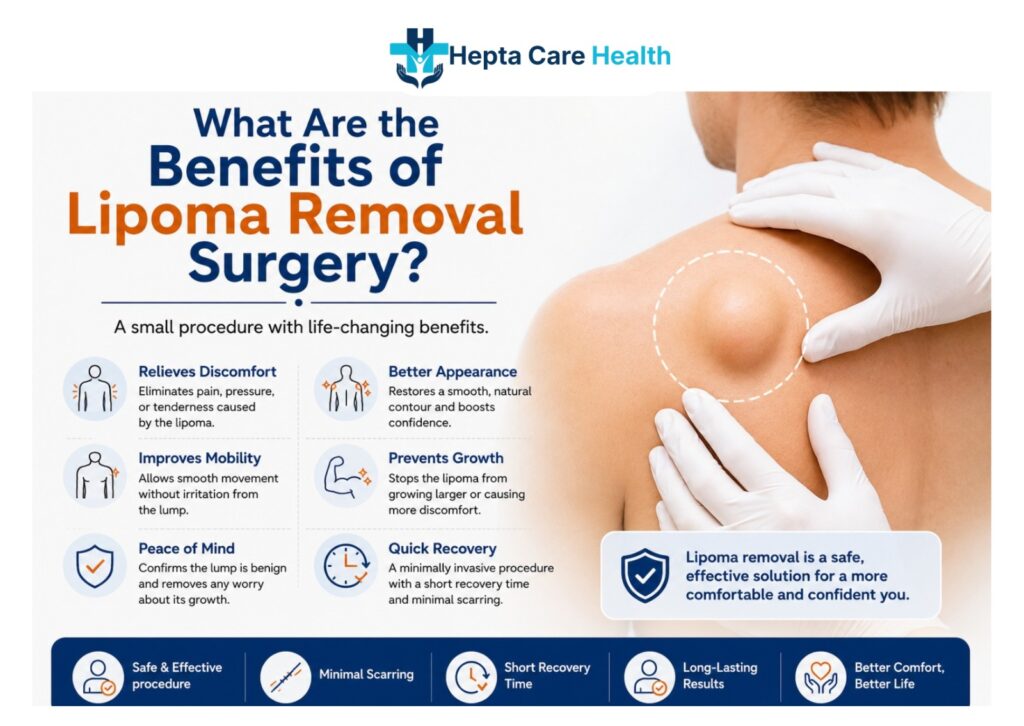
What Are the Benefits of Lipoma Removal Surgery?
Lipoma surgery offers several advantages.
Permanent Removal
The entire lipoma is removed, reducing recurrence risk.
Symptom Relief
Eliminates discomfort caused by pressure on surrounding tissues.
Improved Appearance
Removes visible lumps that may affect confidence.
Better Mobility
Improves movement if the lipoma restricts activity.
Accurate Diagnosis
The removed tissue can be examined in a laboratory for confirmation.
Uses of Lipoma Removal Surgery
Medical Uses
- Relief from pain
- Improved function
- Diagnosis confirmation
- Prevention of complications
Cosmetic Uses
- Improved body appearance
- Enhanced self-confidence
- Removal of visible lumps
Preparation Before Lipoma Surgery
Proper preparation helps ensure a smooth procedure.
Medical Evaluation
Your doctor may review:
- Medical history
- Current medications
- Allergies
- Previous surgeries
Diagnostic Tests
Tests may include:
- Blood tests
- Imaging studies
- Physical examination
Medication Instructions
You may be advised to stop certain medications temporarily before surgery.
Lifestyle Recommendations
Patients may be asked to:
- Avoid smoking
- Stay hydrated
- Follow fasting instructions if anaesthesia is planned
What Happens During Lipoma Surgery?
Lipoma removal is usually performed as an outpatient procedure.
Step 1: Anesthesia
Local anesthesia is commonly used.
Larger lipomas may require sedation or general anesthesia
Step 2: Incision
The surgeon makes a small incision over the lipoma.
Step 3: Lipoma Removal
The fatty mass and surrounding capsule are carefully removed.
Step 4: Closure
The incision is closed using sutures and dressed appropriately.
Procedure Duration
Most procedures take between 20 and 60 minutes depending on size and complexity.
Recovery After Lipoma Treatment
Recovery is generally straightforward.
First Few Days
Patients may experience:
- Mild swelling
- Bruising
- Minor discomfort
Pain is usually manageable with prescribed medications.
One to Two Weeks
- Stitches may be removed if necessary
- Most daily activities can resume
- Swelling gradually decreases
Full Recovery
Complete healing may occur within several weeks.
Recovery time depends on:
- Lipoma size
- Location
- Surgical technique
- Individual healing response
Lifestyle Changes After Lipoma Removal
Although lipomas cannot always be prevented, healthy habits support overall wellness.
Maintain a Healthy Weight
Supports general health and body composition.
Regular Physical Activity
Promotes circulation and overall well-being.
Routine Health Checkups
Helps monitor for any new growths.
Balanced Nutrition
Supports healing and recovery.
Avoid Smoking
Smoking can delay wound healing.
Lipoma Surgery Complications & Risks
Lipoma removal is generally safe, but all surgical procedures carry some risk.
Possible Risks
Infection
May occur at the incision site.
Bleeding
Usually minimal but possible.
Scarring
Small scars are expected after surgery.
Temporary Numbness
May occur if nearby nerves are affected.
Seroma Formation
Fluid may occasionally collect under the skin.
Recurrence
Rare if the entire lipoma and capsule are removed.
Lipoma Treatment Without Surgery
Not all lipomas require surgical intervention.
Observation
Suitable for:
- Small lipomas
- Asymptomatic cases
- Stable growths
Steroid Injections
Can reduce size but rarely eliminate the lipoma completely.
Liposuction
May be useful for certain soft lipomas.
However, recurrence risk may be slightly higher because the capsule is not always fully removed.
Home Remedies for Lipoma
There is limited scientific evidence supporting home remedies for eliminating lipomas.
However, some people use natural approaches to support overall skin and tissue health.
Healthy Diet
A balanced diet supports overall wellness.
Regular Exercise
Promotes healthy metabolism.
Adequate Hydration
Supports general health and recovery.
Warm Compresses
May help relieve mild discomfort but do not remove lipomas.
Important Note
Home remedies cannot reliably dissolve or remove a lipoma. Patients should seek professional medical evaluation for any persistent lump.
Why Choose Heptacare Health for Lipoma Treatment?
Heptacare Health helps patients access experienced surgeons and quality healthcare facilities for lipoma evaluation and treatment.
Key Benefits
Free Consultation with Doctors
Discuss symptoms and treatment options with qualified specialists.
Access to Experienced Surgeons
Connect with healthcare professionals experienced in lipoma removal procedures.
Hospital Selection Assistance
Find hospitals that match your treatment needs and budget.
Financing and No-Cost EMI Support
Explore convenient healthcare financing options.
End-to-End Care Coordination
Receive support throughout consultation, treatment, and recovery.
Transparent Healthcare Guidance
Get clear information regarding procedures, costs, and expected outcomes.
Let's Schedule Your Surgery
Conclusion
Lipomas are common benign fatty tumors that usually do not pose serious health risks. However, when they cause pain, cosmetic concerns, or functional limitations, treatment may be necessary. Surgical excision remains the most effective and permanent solution, offering symptom relief, improved appearance, and diagnostic confirmation.
Understanding the symptoms, diagnosis process, treatment options, benefits, risks, and recovery expectations can help patients make informed decisions about their care. Consulting an experienced healthcare professional is the best way to determine the most appropriate treatment approach for your specific condition.
Frequently Asked Questions
The procedure is usually performed under local anesthesia, making it relatively comfortable. Mild soreness may occur afterward.
Lipomas are generally benign and rarely become cancerous. However, unusual or rapidly growing lumps should be evaluated by a doctor.
Recurrence is uncommon when the entire lipoma and its capsule are removed.
Most lipoma removal procedures take approximately 20–60 minutes.
Coverage depends on the reason for removal and individual insurance policies. Medical necessity may influence eligibility.
©2019. Elements Kit. All Rights Reserved.

Company
Subscribe Now
Don’t miss our future updates! Get Subscribed Today!
@2026 HeptaCare Health- heptacarehealth.com

 The coordinator will understand your symptoms and health condition in detail
 Your consultation will be scheduled at the earliest.