
Best Doctor for Piles Laser Treatment in Visakhapatnam: Complete Expert Guide
Piles (hemorrhoids) affect millions of adults across India, yet many delay seeking medical help due to embarrassment or lack of clarity on whom to consult.
70k+
Happy Patients
50+
Disease
100+
Hospitals
10+
Cities
Book Free Consultation
Free Consultation
No-Cost EMI
Support in Insurance Claim
Why Choosing the Right Piles Doctor in Visakhapatnam Matters
Piles (hemorrhoids) affect millions of adults across India, yet many delay seeking medical help due to embarrassment or lack of clarity on whom to consult. If you are experiencing rectal discomfort, bleeding, or persistent pain in rectum area , finding the right specialist at the right time is essential for effective, lasting relief.
This comprehensive guide developed with clinical insights from anorectal care guidelines — walks you through exactly whom to consult for piles treatment in Visakhapatnam, what qualifications to look for, when to seek urgent care, and what questions to ask before committing to a treatment plan.
What Are Piles? Understanding the Condition Before Choosing a Doctor
Piles, medically referred to as hemorrhoids, are swollen and inflamed veins in the rectum or around the anus. They are classified into:
- Internal piles — Located inside the rectum; usually painless but may bleed
- External piles — Develop under the skin around the anus; often painful and itchy
- Prolapsed piles — Internal piles that protrude outside the anal opening
- Thrombosed piles — Blood clots form inside, causing severe pain and swelling
Understanding the type and grade of your piles determines the most appropriate treatment approach and the specialist best suited to manage your condition.
Which Doctor Should You Consult for Piles Treatment in Visakhapatnam?
1. Proctologist (Colorectal Surgeon) — The Primary Specialist
A proctologist, also known as a colorectal surgeon or proctosurgeon, is the most qualified specialist for the diagnosis, management, and surgical treatment of piles. Their scope of expertise covers all disorders of the:
- Rectum
- Colon
- Anus and surrounding tissues
Proctologists undergo extensive training — typically 8 or more years of combined medical education and specialty residency — focused specifically on anorectal diseases such as piles (hemorrhoids), anal fissures, anorectal fistulas, and colorectal cancer screening.
When to prioritize a proctologist:
- Chronic, recurring, or Grade III/IV piles
- Prolapsed hemorrhoids requiring surgery
- Piles with suspected complications (thrombosis, severe bleeding, prolapse)
- Failed response to conservative or home-based treatments
2. General Surgeon — A Qualified Alternative
If a dedicated proctologist is not immediately accessible in Visakhapatnam, a board-certified general surgeon is a fully competent alternative. General surgeons routinely perform hemorrhoidectomies and other piles-related procedures, and many have significant hands-on experience in anorectal surgeries.
3. Primary Care Physician (Family Doctor / General Physician) — For Early-Stage Piles
At the earliest stages — when symptoms are mild and piles are Grade I or II — your family doctor or general physician can:
- Conduct an initial clinical assessment
- Recommend dietary modifications (high-fibre diet, hydration)
- Prescribe topical medications and stool softeners
- Refer you to a proctologist if symptoms persist or worsen
Important: If conservative treatment does not show improvement within 7–10 days, escalate care to a specialist.
How to Find the Best Piles Specialist in Visakhapatnam: 6 Key Criteria
1. Verify Academic Qualifications and Licensing
A qualified piles specialist in India should hold:
- MBBS from a recognized medical institution
- MS (General Surgery) or MCh (Surgical Gastroenterology / Colorectal Surgery) — postgraduate specialty training
- Valid registration with the Medical Council of India (MCI) or National Medical Commission (NMC)
- Ideally, membership or fellowship with recognized surgical bodies (e.g., Association of Surgeons of India, Colorectal Society of India)
Always verify credentials before scheduling a consultation, as this directly impacts both safety and outcome.
2. Assess Clinical Experience and Procedural Expertise
Piles treatment spans a range of procedures — from lifestyle counseling to minimally invasive techniques to open surgery. Look for a specialist who offers:
- Rubber Band Ligation (RBL) — Non-surgical, effective for Grade I–II internal piles
- Sclerotherapy — Injection-based, minimally invasive option
- Infrared Coagulation — Outpatient procedure using infrared light
- Laser Hemorrhoidoplasty (LHP) — Advanced, minimally invasive laser treatment with faster recovery
- Stapled Hemorrhoidopexy (MIPH) — Procedure for prolapsed hemorrhoids with less post-op pain
- Open or Closed Hemorrhoidectomy — Surgical removal for severe Grade III/IV piles
A surgeon with a minimum of 8 years of post-qualification surgical experience — and hands-on proficiency in modern laser-assisted procedures — is a reliable indicator of clinical competence.
3. Read Patient Reviews and Testimonials
Patient reviews are a valuable and authentic indicator of care quality. When reviewing feedback, pay attention to:
- Communication: Does the doctor explain diagnosis and treatment options clearly?
- Empathy: Do patients feel heard and respected?
- Post-operative care: Is follow-up care attentive and responsive?
- Outcomes: Do patients report successful recovery and minimal recurrence?
Use platforms such as Google Reviews, Practo, JustDial, or hospital websites to gather unbiased patient experiences.
4. Evaluate the Hospital or Clinic Infrastructure
The quality of the healthcare facility where the doctor practises matters significantly. Factors to assess include:
- Accreditation: Is the hospital NABH-accredited or ISO-certified?
- Surgical infrastructure: Does it have modern operating theatres with laser and endoscopic equipment?
- Hygiene and sterilisation protocols: Critical for preventing post-operative infections
- Post-operative care facilities: Availability of trained nursing staff, pain management, and discharge support
- Location and accessibility: Convenient access within Visakhapatnam for pre- and post-surgery visits
5. Assess Communication Quality During Consultation
A skilled surgeon is not just technically proficient — they are also an effective communicator. During your consultation, evaluate whether the doctor:
- Takes time to listen to your complete history without rushing
- Explains your diagnosis in plain, understandable language
- Discusses all available treatment options — surgical and non-surgical
- Is transparent about risks, recovery timelines, and success rates
- Welcomes your questions without dismissing concerns
Doctors who exhibit patience and empathy build stronger doctor-patient relationships, which leads to better adherence, less anxiety, and improved treatment outcomes.
6. Seek Referrals and Second Opinions
- Ask your primary care physician for a trusted referral based on clinical experience
- Consult with family or friends who have undergone piles treatment in Visakhapatnam
- Do not hesitate to seek a second opinion for complex cases or recommended surgery
- Cross-check referrals with your own online research
When Should You Urgently Visit a Piles Specialist in Visakhapatnam?
Many individuals delay consulting a doctor, hoping piles will resolve on their own. While mild piles can sometimes improve with dietary changes, untreated or worsening hemorrhoids carry significant health risks.
Seek immediate medical attention if you experience:
- Rectal bleeding — Bright red blood on toilet paper, in the toilet bowl, or in stools
- Prolapse — Tissue protruding from the anus that cannot be pushed back in
- Severe or persistent pain — Especially if accompanied by swelling or a hard lump around the anus
- Thrombosed hemorrhoid — Sudden, intense anal pain with a bluish or dark swelling (requires urgent treatment within 72 hours)
- Anaemia symptoms — Unexplained fatigue, pale skin, or dizziness caused by chronic rectal blood loss
- Failure of OTC treatments — Over-the-counter creams or suppositories showing no relief within 7 days
- Changes in bowel habits — Persistent changes in stool colour, consistency, or frequency alongside rectal bleeding (rule out other conditions)
⚠️ Clinical Note: Rectal bleeding should never be self-diagnosed as “definitely piles.” It can also signal colorectal polyps, inflammatory bowel disease, or colorectal cancer. Always get a proper clinical evaluation.
Treatment Options for Piles in Visakhapatnam: What to Expect
Your specialist will recommend a treatment plan based on the grade and severity of your condition:
Grade | Description | Recommended Treatment |
Grade I | Internal, no prolapse | Dietary changes, medications, sclerotherapy |
Grade II | Prolapse during bowel movement; retracts spontaneously | Rubber band ligation, IRC |
Grade III | Prolapse requiring manual reduction | Rubber band ligation, laser surgery, MIPH |
Grade IV | Permanent prolapse; cannot be reduced | Hemorrhoidectomy, MIPH, laser surgery |
Advantages of Laser-Assisted Piles Surgery
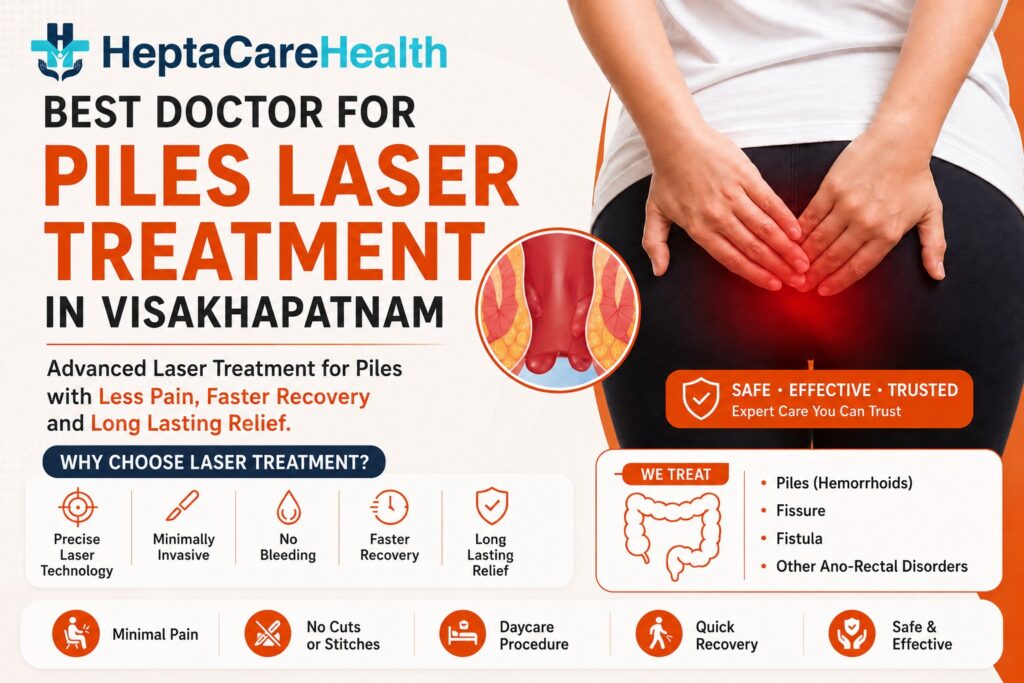
Modern laser hemorrhoidoplasty (LHP) is increasingly preferred over traditional open surgery due to:
- Minimal bleeding during and after the procedure
- Less post-operative pain compared to conventional hemorrhoidectomy
- Faster recovery — most patients return to normal activities within 3–5 days
- Day-care procedure — typically no overnight hospital stay required
- Lower risk of complications such as infection or anal stricture
Questions to Ask Your Piles Doctor Before Starting Treatment
Before finalising your choice of specialist and treatment plan, ask:
- What is the grade/severity of my piles based on the examination?
- What treatment options are suitable for my specific case?
- Is surgery absolutely necessary, or are there effective non-surgical alternatives?
- What are the risks, side effects, and recovery time associated with my recommended treatment?
- How many procedures of this type have you performed, and what is your success rate?
- What lifestyle changes do I need to make to prevent recurrence?
- What does the post-procedure follow-up plan look like?
A transparent, patient-centred specialist will welcome each of these questions and provide detailed, honest answers.
Lifestyle Modifications to Support Piles Treatment
While medical treatment addresses the existing condition, the following lifestyle changes reduce recurrence:
- High-fibre diet: Include fruits, vegetables, whole grains, and legumes to soften stools
- Adequate hydration: Drink 8–10 glasses of water daily to prevent constipation
- Avoid straining: Never strain during bowel movements; do not delay when you feel the urge
- Regular physical activity: 30 minutes of moderate exercise daily improves bowel regularity
- Limit prolonged sitting: Take breaks every hour if your work involves long sitting periods
- Warm sitz baths: Soaking the anal area in warm water for 10–15 minutes helps relieve discomfort during recovery
- Avoid spicy foods and alcohol: These can aggravate symptoms in active piles
Conclusion
Finding the right doctor for piles treatment in Visakhapatnam is the single most important step toward effective, safe, and lasting recovery. Whether you begin with a general physician for mild symptoms or proceed directly to a proctologist for advanced care, prioritise qualifications, experience, modern treatment capabilities, and the quality of patient communication.
Do not delay seeking care the earlier piles are diagnosed and treated, the simpler, safer, and more affordable the treatment options become. Schedule a consultation with a qualified piles specialist in Visakhapatnam today and take the first step toward lasting relief.
Frequently Asked Questions
Yes. Grade I and Grade II piles often respond well to dietary changes, medications, and minimally invasive office procedures like rubber band ligation. However, Grade III and IV piles typically require surgical intervention for lasting relief.
Modern techniques, particularly laser surgery, are associated with significantly less pain than traditional open hemorrhoidectomy. Most patients manage post-operative discomfort effectively with prescribed pain medications and report returning to normal activities within a week.
Recovery varies by procedure. Laser and stapled surgeries typically allow patients to resume daily activities within 3–7 days. Full recovery from traditional hemorrhoidectomy may take 2–4 weeks.
Most often, piles are benign. However, symptoms like rectal bleeding and changes in bowel habits should be evaluated by a specialist to rule out other colorectal conditions, including cancer.
You can book through hospital websites, health platforms like Practo or JustDial, by calling the clinic directly, or through a referral from your general physician.